Centerville Road Electric Reliability Project
As part of its ongoing commitment to provide best-in-class services, the City of Tallahassee is underway with construction on an electric infrastructure enhancement project along Centerville Road. This project will further strengthen the system’s resilience against severe weather and improve reliability.
Work includes replacing the power lines and poles along Centerville Road from Hodges Drive to roughly Potts Road.
Specifically, the project scope is to re-conductor a 4/0 and 559 lineups of mixed construction to a double 559 Hendrix. The 559 Hendrix is a stronger, tree-coded cable and allows for a narrower system profile, ideal for the canopy road environment along Centerville Road.
The project has been engineered so that no planned outages or tree removal are anticipated.
The project involves both daytime and nighttime work, depending on the phase of construction. Efforts will be made to minimize impacts from construction noise and nighttime work zone lighting.
City Electric crews are performing the work, and safety is the top priority. As such, Centerville Road is being closed in four phases during construction, with only portions of the roadway closed at a time. Emergency vehicles will always be allowed through the work zone, while regular traffic will be detoured around the closure area. All detours will be clearly marked, and access to private property will be maintained.
Thank you for your support during the first, second and third phases of power line upgrades along Centerville Road.
Phase 4 begins on September 25 and includes replacing the power lines and poles along Centerville Road from Woodgate Way to roughly Potts Road.
Construction will take place overnight from 8 p.m. to 6 a.m. seven days a week. Efforts will be made to minimize impacts from construction noise and nighttime work zone lighting. A detour map is available on this page. Regular traffic will be detoured as follows:
- Northbound traffic on Centerville Road will be detoured at Betton Road.
- Southbound traffic on Centerville Road will be detoured at Capital Circle NE.
- Northbound traffic on Blair Stone Road will be detoured at Miccosukee Road.
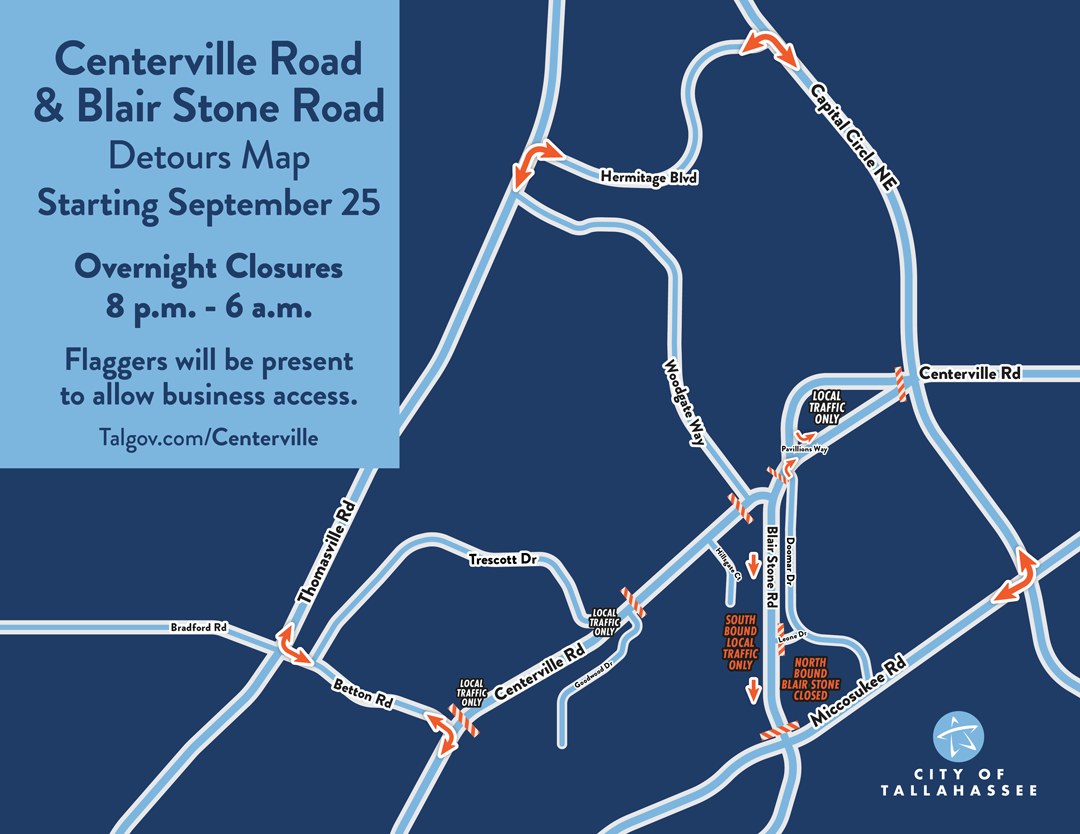
View a larger, printable version of this map here.
Over the last 10 years, the City’s Electric Utility has implemented other system enhancements on and near the corridor. Completing this project will help meet the system’s modern operational needs, further strengthen the system against severe weather and create new redundancies and efficiencies to improve reliability.